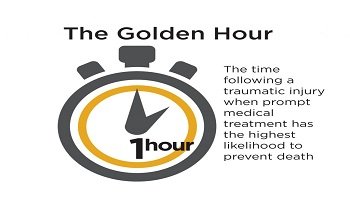
Is one hour after event (accident, severe symptoms, etc),
When victim is not under hospital care :- on road, at home, outdoors etc.
Till patient is hospitalized or treated by doctor.
The golden hour after an event is very critical for victim/patient survival and improvement
when at home or outdoors till patient/victim is taken to the hospital. The various events after which action taken during the Golden hour is very important are :
Fainting
Can be due to stroke, heart attack, hypoglycaemia, arrhythmia, electrolyte imbalance, etc.
Excruciating pain in heart, radiating pain in shoulder, vomiting can be stroke, heart attack.
Can be due to Drowning.
In such case Cardiopulmonary resuscitation (CPR) can be given. Accidents
Haemorrhage leading to blood loss, cut or severance of body part, fractures, etc. Burns
Electric / Chemical / Kitchen Epilepsy
Epilepsy attack/fit/convulsion, patient of epilepsy, febrile fever.
Golden hour advice by HH:
Fainting: Family and people around are not aware of cause of fainting.
If patient is unknown. Make him/her sit or lie down comfortably with adequate air ventilation. Provide water if required. If person is known to be on diabetic medication he/she may show hypoglycaemic state due to inadequate diet/food. Then provide glucose water or sugar candy (Sugar Toffee).
Hyperglycaemia based episodes need immediate medical attention/medication with prescribed anti-diabetic drugs.
Advisable to take patient on stretcher to hospital without any exertion.
Patient should get minimum stress in the journey to hospital.
Cardiac Events:-
Pain in the heart and radiating pain in shoulder and arms. The victim might be having an angina attack or heart attack.
Please keep prescribed nitrate medicine eg. Sorbitrate® or any other sub lingual nitrate tablet below the tongue immediately with the advice of physician.
Patient with history of thrombosis might take low dose aspirin with advice from physician.
First Aid Measures for Haemorrage or Fracture
Apply direct pressure on the cut or wound with a clean cloth, tissue, or piece of gauze until bleeding stops.
If blood soaks through the material, don’t remove it. Put more cloth or gauze on top of it and continue to apply pressure.
If the wound is on the arm or leg, raise limb above the heart, if possible, to help slow bleeding.
If in accident victims limb is cut/ severed, Severed limb to be immediately washed with clean water and transported in ice box to hospital along with victim.
The preserved cut limb may have chance to be stitched back with immediate surgery.
If the hand is fractured it can be tied with a cloth close to the body and patient should be taken to the hospital immediately.
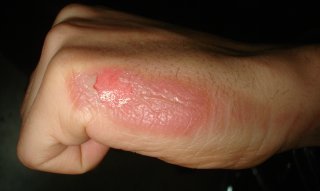
First Aid Measures for burns
Immediately get the person away from the heat source to stop the burning
Cool the burn with cool or lukewarm running water for 20 minutes – don't use ice, iced water, or any creams or greasy substances such as butter
Remove any clothing or jewellery that's near the burnt area of skin, but don't move anything that's stuck to the skin
Cover the burn, a clean plastic bag could also be used for burns on your hand
Antiseptic hydrogels for burns may be applied at burnt site and victim should be taken to doctor for moderate and severe burns.
First Aid Measures for Epilepsy
Stay calm.
Look around - is the person in a dangerous place? If not, don't move them. Move objects like furniture away from them.
Note the time the seizure starts.
Stay with them. If they don't collapse but seem blank or confused, gently guide them away from any danger. Speak quietly and calmly.
Cushion their head with something soft if they have collapsed to the ground.
Don't hold them down.
Don't put anything in their mouth.
Check the time again. If a convulsive (shaking) seizure doesn't stop after 5 minutes, call for an ambulance.
After the seizure has stopped, put them into the recovery position and check that their breathing is returning to normal. Gently check their mouth to see that nothing is blocking their airway such as food or false teeth. If their breathing sounds difficult after the seizure has stopped, call for an ambulance.
Stay with them until they are fully recovered.
Emergency Helpline numbers for accidents
Police
100
Ambulance
102
Fire Brigade
103
Emergency Disaster Management
108
Burns
What are Burns?
1) A burn is a type of injury to skin, or other tissues, caused by heat, electricity, chemicals, friction, or radiation.
2) Most burns are due to heat from hot liquids, solids, or fire.
3) Burns can also occur as a result of self harm or violence between people.
Types of burns
Chemical Burns
1) Chemical burns can be caused by over 25,000 substances, most of which are either a strong base (55%) or a strong acid (26%).
2) Common agents include: sulfuric acid as found in toilet cleaners, sodium hypochlorite as found in bleach, and halogenated hydrocarbons as found in paint remover, etc.
3) Hydrofluoric acid can cause particularly deep burns that may not become symptomatic until some time after exposure.
4) Formic acid may cause the breakdown of significant numbers of red blood cells.
5) Chemical burns involving elemental metals (lithium, potassium, sodium and magnesium) should not be irrigated with water as this can result in a chemical reaction that causes burns to worsen. These types of chemical burns should be soaked with mineral oil while waiting for medical attention.
Electric Burns
1) Electrical burns are injuries that are caused by an electric current.
2) The electric current can pass through your body and damage tissues or organs.
3) Common causes of electrical burns in children are electrical cords (60%) followed by electrical outlets (14%).
4) Lightning may also result in electrical burns.
5) Electrical injuries primarily result in burns, they may also cause fractures or dislocations.
First Aid Measures for burns
Immediately get the person away from the heat source to stop the burning
Cool the burn with cool or lukewarm running water for 20 minutes – don't use ice, iced water, or any creams or greasy substances such as butter
Remove any clothing or jewellery that's near the burnt area of skin, but don't move anything that's stuck to the skin
Cover the burn, a clean plastic bag could also be used for burns on your hand
Antiseptic hydrogels for burns may be applied at burn site and victim should be taken to doctor for moderate and severe burns.
CPR
What is CPR?
Cardiopulmonary resuscitation (CPR) can help save a life during a cardiac or breathing emergency.
However, even after training, remembering the CPR steps and administering them correctly can be a challenge.
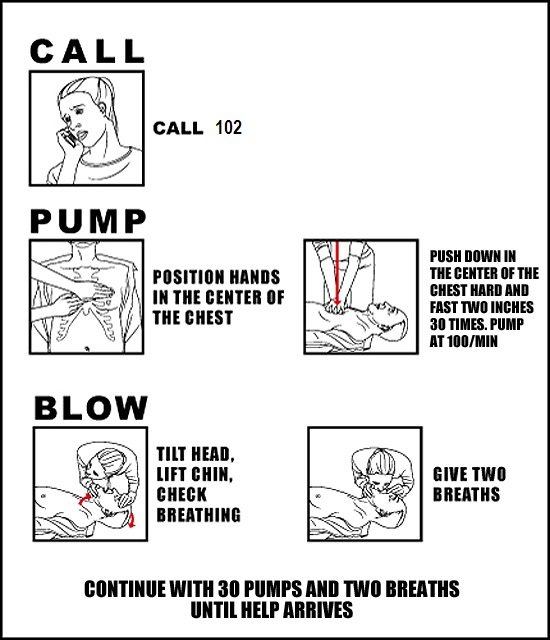
In order to help you help someone in need, we've created this simple step-by-step guide that you can print up and place on your refrigerator, in your car, in your bag or at your desk.
Before Giving CPR
1) Check the scene and the person. Make sure the scene is safe, then tap the person on the shoulder and shout "Are you OK?" to ensure that the person needs help.
2) Call Ambulance for assistance.
3) Open the airway. With the person lying on his or her back, tilt the head back slightly to lift the chin.
4) Check for breathing. Listen carefully, for no more than 10 seconds, for sounds of breathing. (Occasional gasping sounds do not equate to breathing.) If there is no breathing begin CPR.
While giving CPR
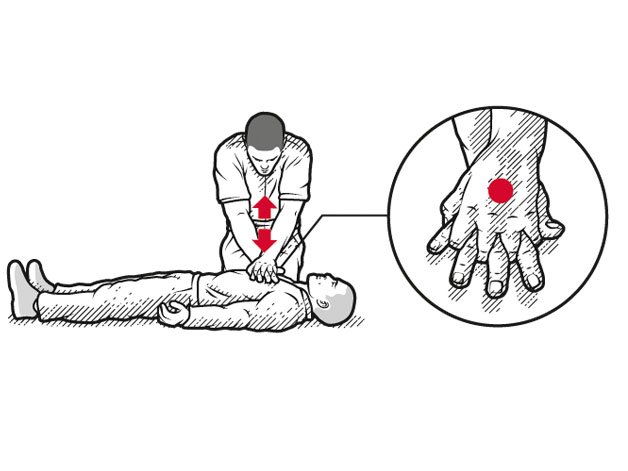
1) Place your hands, one on top of the other, in the middle of the chest. Push hard, push fast. Use your body weight to help you administer compressions that are at least 2 inches deep and delivered at a rate of at least 100 compressions per minute.
2) Deliver rescue breaths. With the person's head tilted back slightly and the chin lifted, pinch the nose shut and place your mouth over the person's mouth to make a complete seal. Blow into the person's mouth to make the chest rise. Deliver two rescue breaths, then continue compressions.
3) Continue CPR steps. Keep performing cycles of chest compressions and breathing until the person exhibits signs of life, such as breathing, and trained medical responder arrives on scene.