Menopause is a normal physiologic event, defined as the final menstrual period.
Complete absence or loss of periods for 12 consecutive months is called as menopause.
Stages of Menopause?
Perimenopause/ Menopausal Transition: time of changes in hormone levels and menstrual cycles (irregular, excessive bleeding),variation in the length of the menstrual cycle
Menopause
Post menopause: Period after Menopause
Average age of occuring
It occurs at an average age of 52 years, but the age of natural menopause can vary widely from 40 to 58 years.
Signs & Symptoms
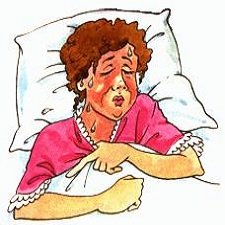
Changes in your period: time between periods or flow may be different. Hot flashes (“hot flushes”): getting warm in the face, neck & chest with and without sweating. Night sweats: that may lead to problems sleeping and feeling tired, stressed or tense. Vaginal changes: the vagina may become dry and thin, and sex may be painful. Thinning of bones: which may lead to loss of height and bone breaks (osteoporosis).
Risk of Diseases
Cardiovascular diseases: hyperlipidemia, hypertension Metabolic syndromes: diabetes mellitus, obesity. Osteoporosis: decreased bone mineral density. Thyroid diseases: hypo or hyperthyroidism . Breast cancer Ovarian cancer Endometrial cancer Cervical cancer
[Consult the Physician/ Gynecologist for ailments associated with menopause.]
Changes in the body
Vulvo-vaginal changes: vaginal dryness, irritation burning sensation, impaired sexual function Body weight gain(refer to the diet chart) Skin: decreased thickness & elasticity, loss of collagen, wrinkling Hair: loss or excessive facial hair growth Eyes: dryness (Use eye drops, gels containing Glycerin, Propylene glycol,Carboxy methyl cellulose sodium, povidone) Teeth & oral cavity: teeth loss due to decreased bone mineral density. (Use mouthwashes containing chlorhexidine, mint )
[To be strictly taken after consultation with physician / Gynecologists]
Clinical Issues
Urinary incontinence/ involuntary urination (loss of bladder control)
Decline in fertility
Uterine bleeding
Sleep disturbances
[ Consult the physician/Gynecologist for any clinical issues associated with menopause]
Diagnosis
Absence of menstrual period for a year
Based on symptoms such as hot flashes, night sweats
Blood tests can measure the levels of two hormones in the blood:
Follicle stimulating hormone (FSH):
Elevated blood levels of FSH
Estradiol:
Low blood levels of estrogens.
How are Cardiovascular Diseases diagnosed?
Regular monitoring of blood pressure.
Screening for blood levels of LDL, HDL cholesterol (quarterly , yearly)
Body Mass Index (kg/m2).
According to WHO Global Database
Classification
BMI (kg/m2)
Underweight
< 18.50
Normal Weight
18.50 - 24.99
Overweight
> 25.00
Pre-obese
25.00 - 29.99
Obese
Class I
Class II
Class III
> 30.00
30.00 - 34.99
35.00 - 39.99
> 40.00
How is diabetes mellitus II diagnosed?
Screening for diabetes with:
Glycated hemoglobin (HbA1c)
Fasting plasma glucose or
An oral glucose tolerance test should be considered for all women aged 45 years and is strongly recommended if women are overweight or obese.
How is osteoporosis diagnosed?
Radiography (X-ray)
The diagnosis of osteoporosis is established by measurement of bone mineral density by dual-energy x-ray absorptiometry (DXA) of the spine, hip, and/or forearm (T-score of -2.5 or lower) FRAX (WHO Fracture Assessment Tool) FRAX® score estimates chance of breaking a hip or other major bones over the next ten years.
Laboratory Testing
Blood Calcium Levels
24-hour Urine Calcium Levels
Thyroid function Test
Parathyroid Hormone Levels
How are thyroid diseases diagnosed?
Measurement of thyroid stimulating hormone is the initial step in assessing thyroid function (TSH is increased during hyperthyroidism & lowered in hypothyroidism).
TSH levels
T4 levels
T3 levels
Thyroid-stimulating immunoglobulin (TSI) test
Diagnosis of subclinical thyroid disorders requires repeated monitoring because laboratory testing often returns to normal with continued observation.
The thyroid examination should evaluate for the presence of thyroid nodules.
How is breast cancer diagnosed?
Physical examination (examined for any lumps in suspicious areas)
Imaging tests used to evaluate breast
Diagnostic Mammography: A mammogram is an x-ray of the breast
Ultrasound: It uses high-frequency sound waves to create an image of the breast tissue. An ultrasound can distinguish between a solid mass, which may be cancer, and a fluid-filled cyst, which is usually not cancer.
MRI (Magnetic Resonance Imaging): An MRI uses magnetic fields, not x-rays, to produce detailed images of the body. An MRI can also be used to measure the tumor size.
How frequently breast examinations tests should be performed?
According to American Cancer Society Guidelines for the Early Detection of Cancer;
Yearly mammograms starting at age 40 and continuing for as long as a woman is in good health.
Clinical Breast Exam (CBE) about every 3 years for women in their 20s and 30s and every year for women 40 and over.
Women should know how their breasts normally look and feel and report any breast changes to a health care provider right away.
Breast Self-Exam (BSE) is an option for women starting in their 20s.
How cervical cancer is diagnosed?
The Pap test (or Pap smear) looks for cancers and pre-cancers in the cervix (the lower part of the uterus that opens into the vagina).
How often Pap test should be performed?
Talk with your doctor about what is best for you.
If you are between ages 21 and 29, you should get Pap test every 3 years.
If you are between ages 30 and 64, you should get a Pap test and Human Papilloma Virus (HPV) test together every 5 years or a Pap test alone every 3 years.
Treatment
HRT (Hormone Replacement Therapy)
Estrogen is available as a pill, capsules (taken orally) or as a transdermal patch (applied to the skin).
Progesterone is available as a pill or as a vaginal suppository.
For women taking estrogen and progesterone, combined pills and patches also are available
[To be strictly taken after consultation with Physician /Gynecologist ]
What is Hormone Replacement Therapy(HRT)?
Lower hormone levels in menopause may lead to hot flashes, vaginal dryness and thin bones. To help with these problems, women are often given estrogen or estrogen with progestin (another hormone) which is termed as Hormone Therapy
[One should go for HRT only after strict consultation with Physician/ Gynecologist]
What are the benefits of HRT?
Relief from vaginal discomfort, hot flushes, vaginal dryness, sexual dysfunction and general improvement in quality of life in peri-menopausal symptomatic women.
Are there any long term effects of HRT?
An increased risk of breast cancer was seen with 3 to 5 years of estrogen-progestogen therapy, ovarian, endometrial, colorectal cancer.
Increases the risk of Venous thrombo-embolism (VTE)
Stroke
Depression, irritability
What are the treatment options for vaginal dryness?
First step is to ensure that you increase your water intake in order to hydrate your body.
Natural moisturisers and lubricants: sweet almond oil, inclusion of flax seed oil in diet.
Vaginal estrogen tablet,Vaginal estrogen cream, Vitamin E vaginal suppositories.
[To be taken strictly after consultation with Physician /Gynaecologist.]
Control
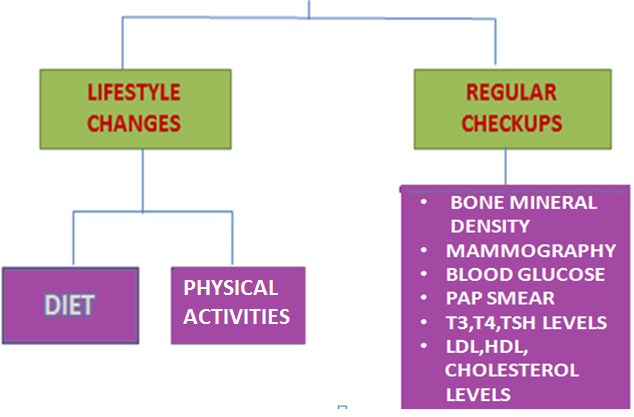
Regular Checkups
Current guidelines generally include:
Screening for diabetes with glycated haemoglobin
(HbA1c), fasting plasma glucose, or an oral glucose tolerance test (monthly,quaterly)
Mammograms every 1 to 2 years, starting at age 40 to 50 years until age 70;
Pap smears every 3years or every 5 years with human papillomavirus co-testing until age 65;
Colonoscopy every 10 years, starting at age 50 until age 75
Bone Mineral Density